Hey Paul! Do you remember Joe Schiferl's velocity and how loud it was when it left
Oshkosh? Proving that you can kill people with sound good lord that was loud. Even
when he was outta sight. I could clearly hear his airplane. Anyway I thought that the
concept for cooling was interesting. but I was wondering if the shroud that he had
behind his airplane where the exhaust exited out the back there! I was wondering if
that whole thing couldn't be turned into some kind of muffler to get the D.B's down a
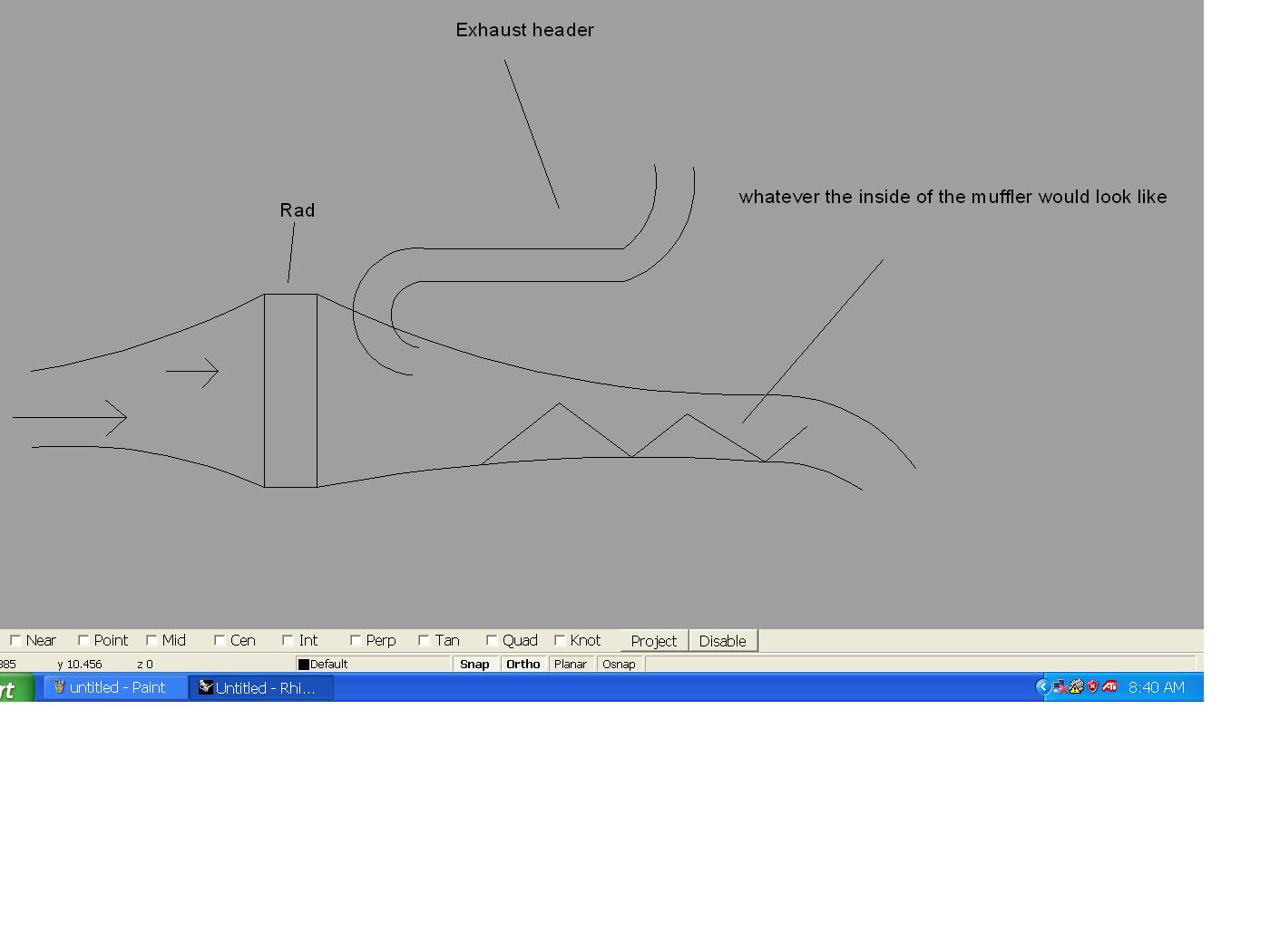
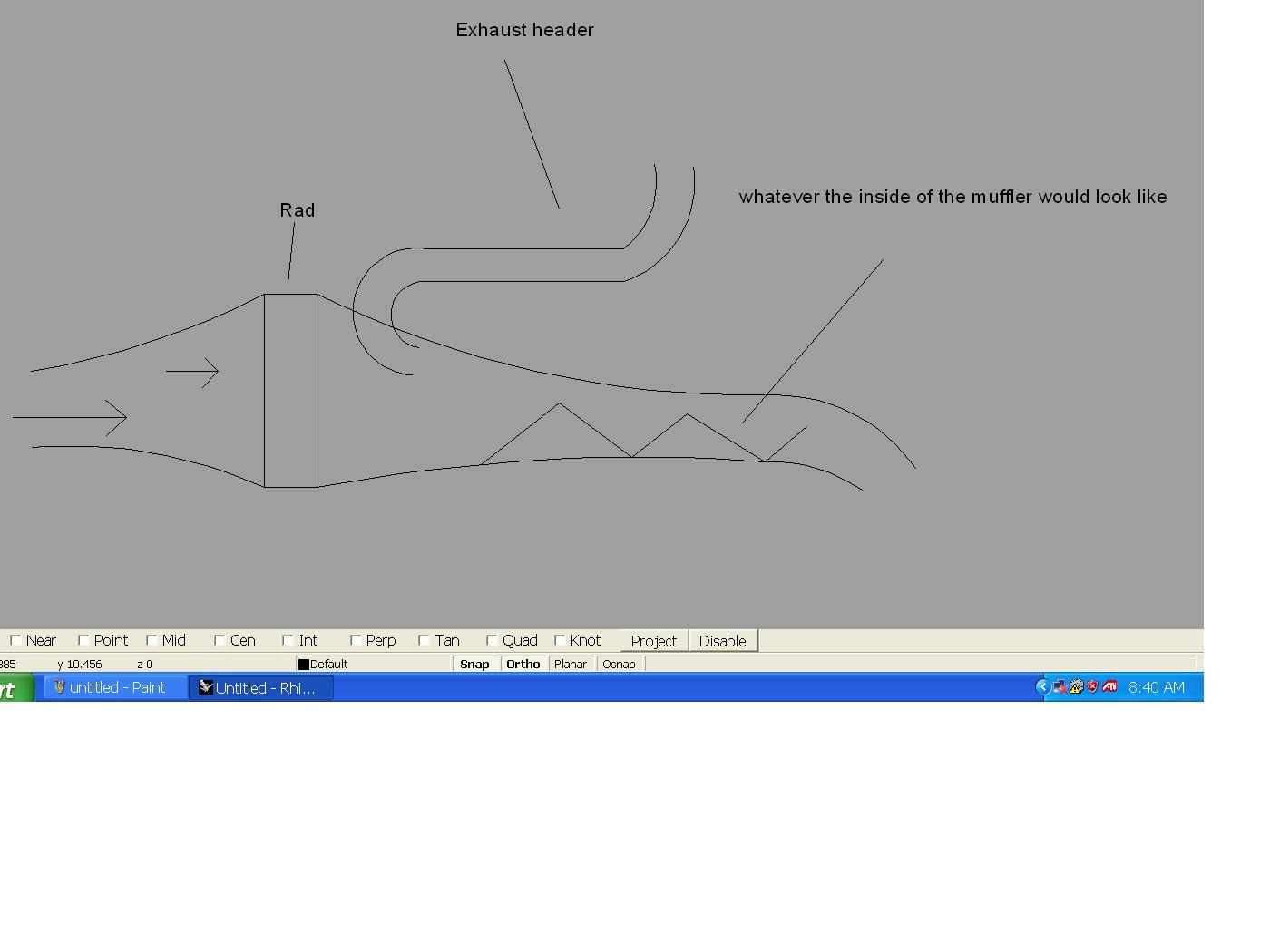
bit. Here is the drawing of what I think it may look like.
may work on my Long ez.
Tony
No muffler. Just an augmenter. You can hear all rotaries miles
away as they have a unique sound.
Paul Lamar
Paul there is no doubt that rotaries have a unique sound but the Power sport birds
where not that loud. Joe's airplane was in a class by itself so about the drawing I
sent you is it correct to make that portion behind the rad into a muffler? Because
after talking to Joe he wasn't sure what to do with it.
Tony
I was kind of tired last night after traveling all day from the mid west
so I did not convert the dwg file to a jpg. Here is how to do it on
your own. When you have the dwg on your screen in the drawing program
you use, press shift Print Screen on your keyboard. A bit mapped screen shot
of the dwg will be loaded into the Windows clip board.
Then goto to All Programs > Accessories and run Windows Paint.
Go up to Edit while in Paint and click on Paste. Your dwg will magically
appear on the screen. Save as a jpg. Now if you have photo shop
or some other program you can crop off all the border stuff
that MS paint leaves all around the out side of the jpg.
Also don't use spaces in the file names as a lot of older programs
can't deal with spaces in the file names. Many people on here do not
have any dwg program let alone ACAD so a jpg is called for.
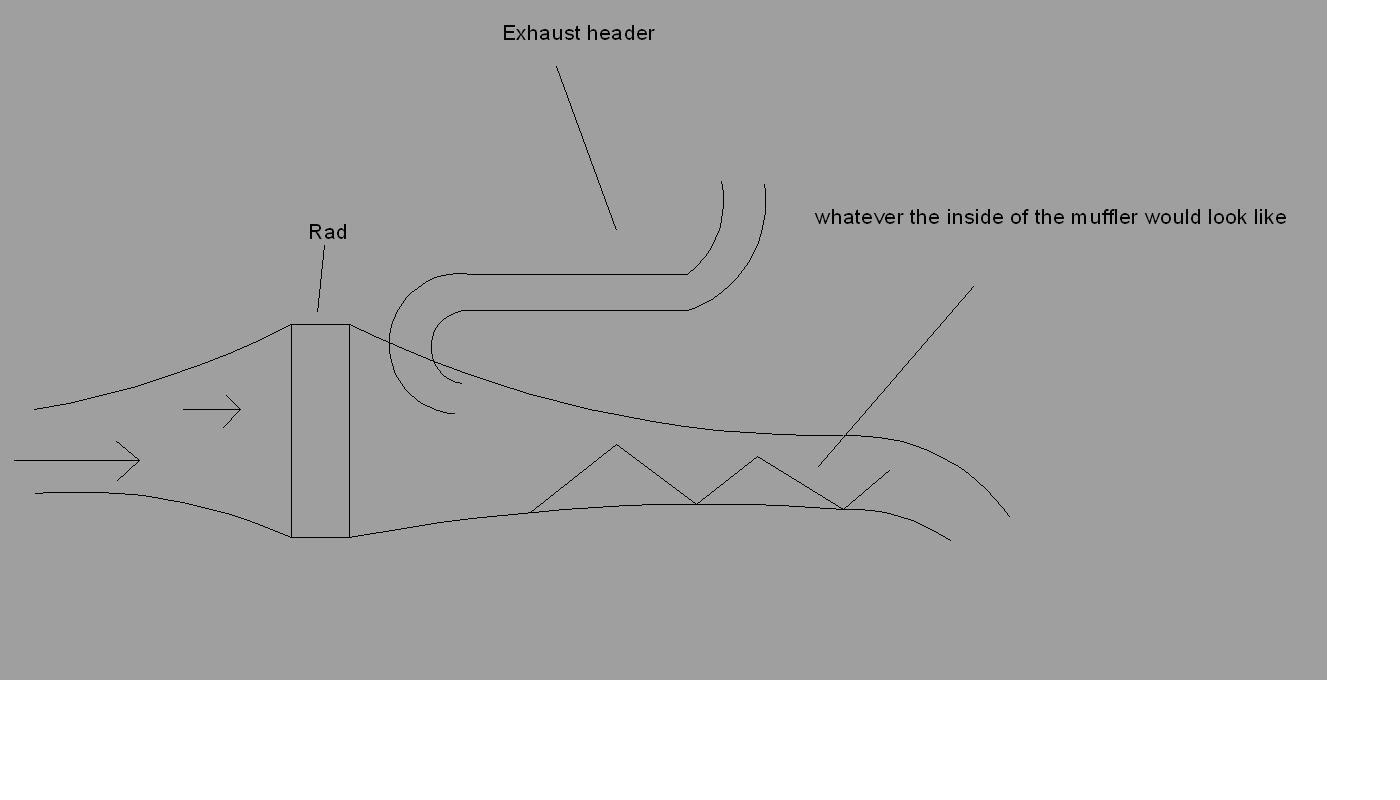
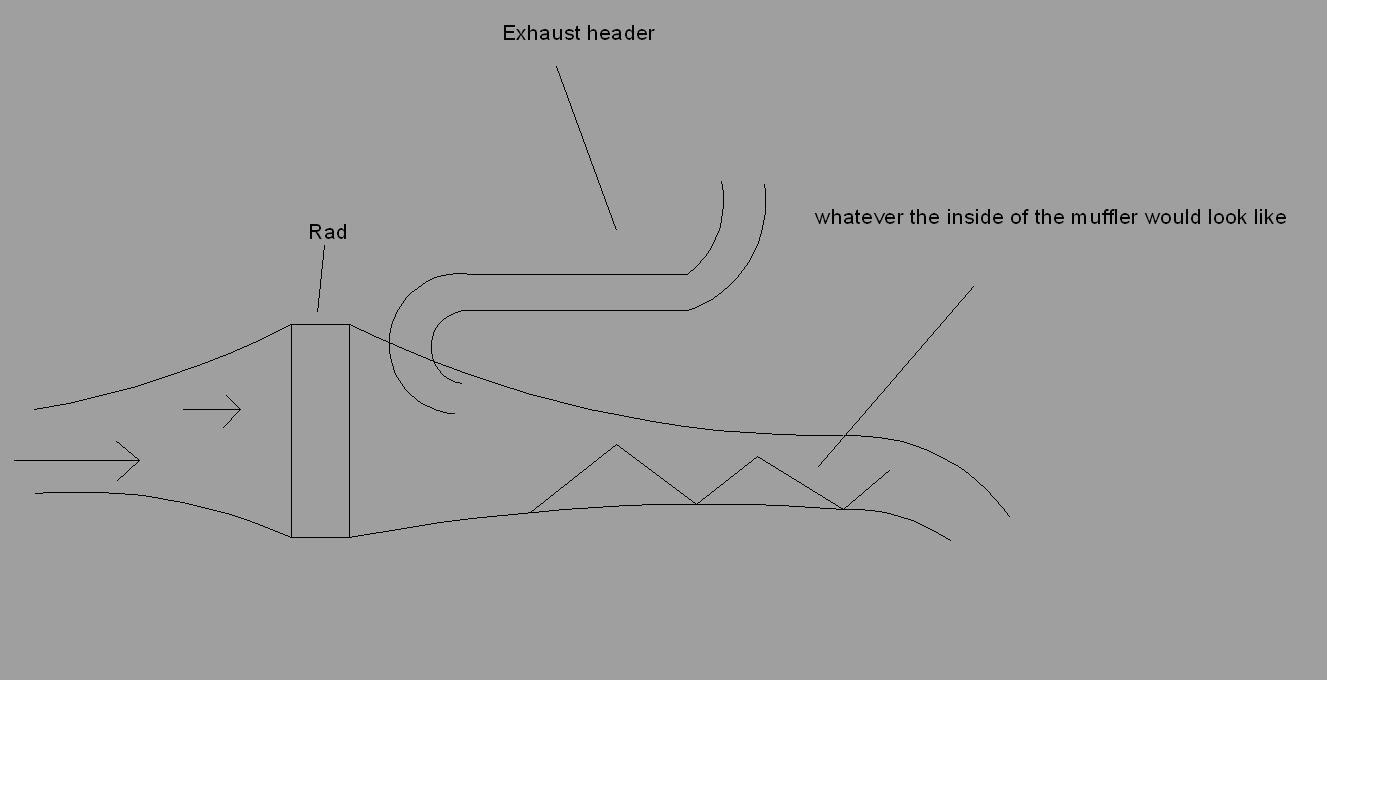
I did all that and this is what it looks like.
Now we can comment on the idea. Anything you put in an augmenter
(AKA Ejector) will tend to defeat its function as it will slow the air flow.
You might also use two smaller rectangular ejectors
rather than one large round one. That should quiet them somewhat.
I cannot say however what it will sound like and how loud
it will be. The fish tails shown in this illustration will
also help quiet the exhaust.
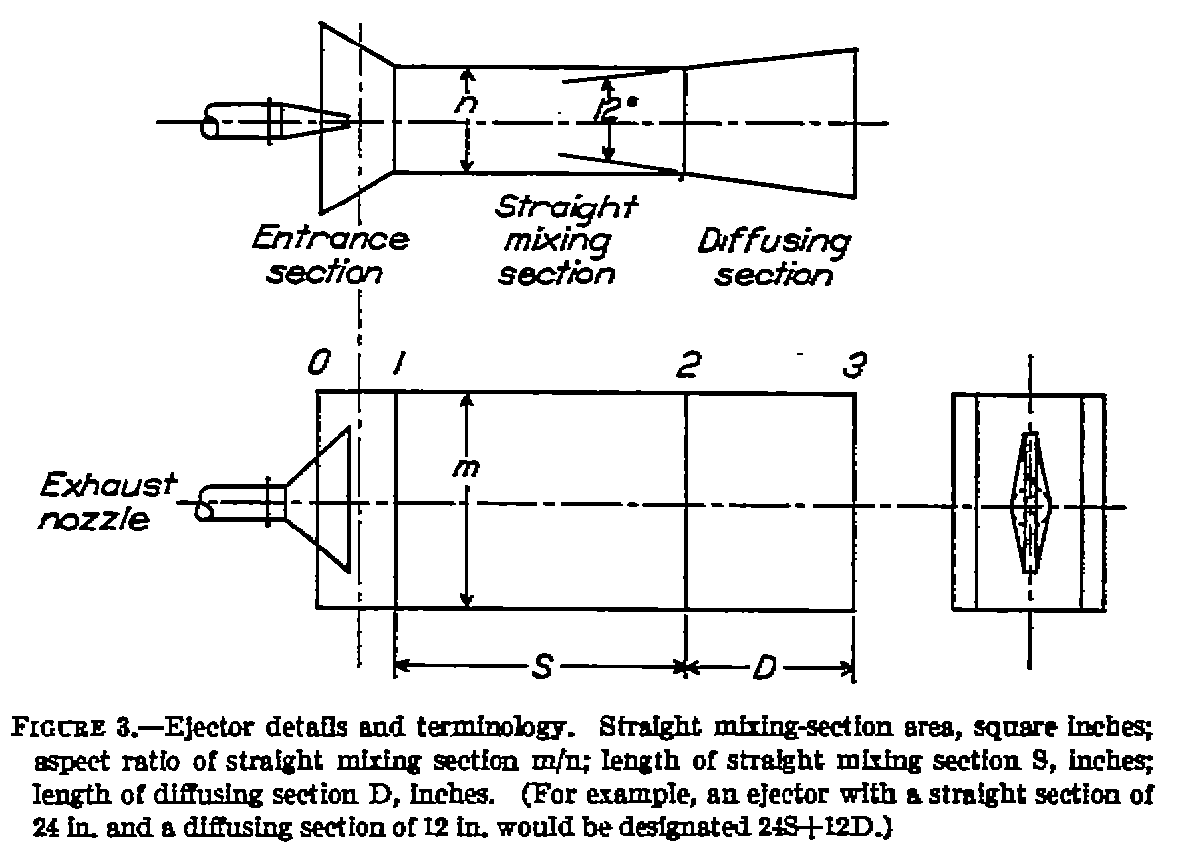
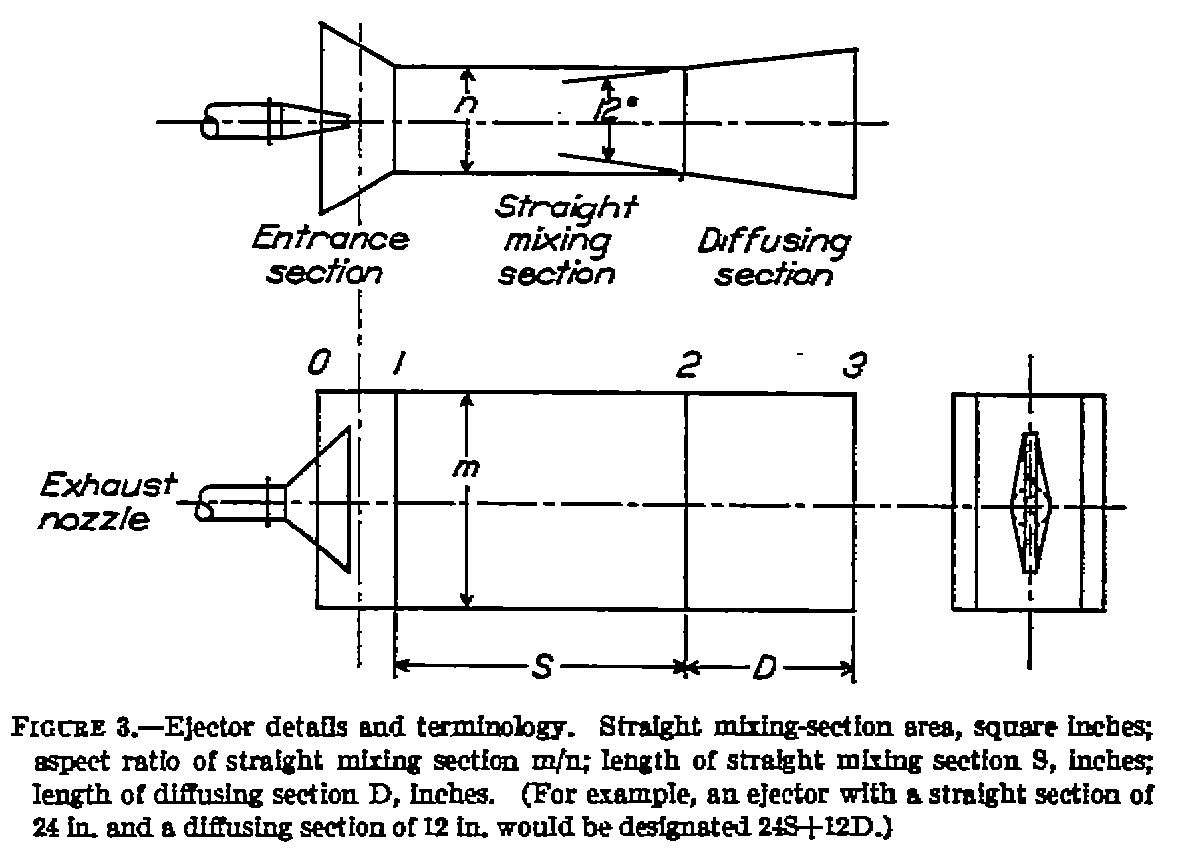
Here is an illustration from
http://naca.larc.nasa.gov/
Ejector-retang-Report-818.pdf
BTW On pusher airplanes the prop tends to chop up the sound waves.
Paul Lamar
The Rotary Engine NewsLetter. Powered by Linux.
ACRE NL web site.
http://www.rotaryeng.net
Copyright 1998-2005 All world wide rights reserved.
**********************************************************
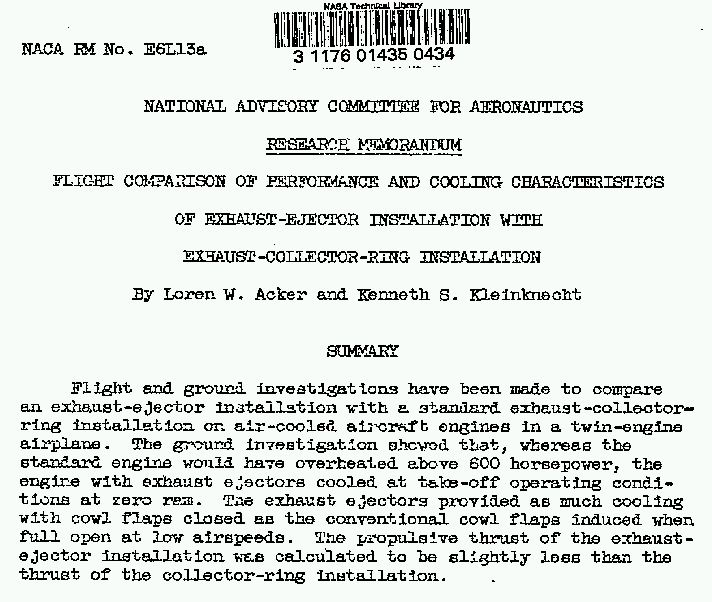
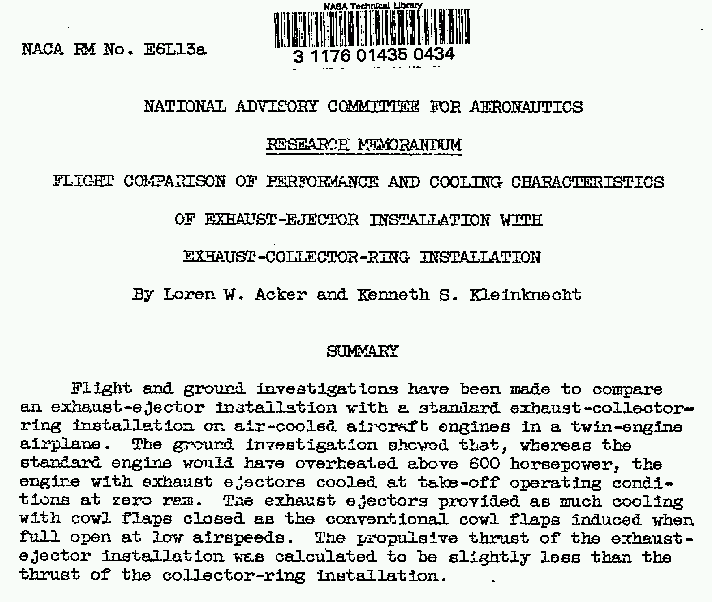
2715. Acker, Loren W Kleinknecht, Kenneth S , ***Flight comparison of
      performance and cooling characteristics of exhaust-ejector
        installation with exhaust-collector-ring installation ,
        <http://naca.larc.nasa.gov/reports/1947/naca-rm-e6l13a/>* NACA
        RM-E6L13a , February 14, 1947 , pp. 37 .

We have this one.
2259. Manganiello, Eugene J Bogatsky, Donald , ***An experimental
      investigation of rectangular exhaust-gas ejectors applicable for
      engine cooling ,
         <http://naca.larc.nasa.gov/reports/1945/naca-report-818/>* NACA
        Report 818 , 1945 , pp. 19 .


We have this one too. Not very relavent.
4694. Fred D. Kochendorfer and Morris D. Rousso, ***Performance
        characteristics of aircraft cooling ejectors having short
        cylindrical shrouds,
        <http://naca.larc.nasa.gov/reports/1951/naca-rm-e51e01/>* NACA RM
        E51E01, May 1951, pp. 41.


4760. Ellis, C. W., Hollister, D. P. and Sargent, A. F., Jr.,
        ***Preliminary investigation of cooling-air ejector performance at
        pressure ratios from 1 to 10 ,
        <http://naca.larc.nasa.gov/reports/1951/naca-rm-e51h21/>* NACA
        Research Memorandum E51H21, 1951, pp. 23.

5399. Greathouse, W. K. and Hollister, D. P., ***Preliminary air-flow
      and thrust calibrations of several conical cooling-air ejectors
        with a primary to secondary temperature ratio of 1.0 I :diameter
        ratios of 1.21 and 1.10 ,
        <http://naca.larc.nasa.gov/reports/1952/naca-rm-e52e21/>* NACA
        Research Memorandum E52E21, 1952, pp. 26.

5433. Greathouse, W. K. and Hollister, D. P., ***Preliminary air-flow
      and thrust calibrations of several conical cooling-air ejectors
        with a primary to secondary temperature ratio of 1.0. II :diameter
        ratios of 1.06 and 1.40 ,
        <http://naca.larc.nasa.gov/reports/1952/naca-rm-e52f26/>* NACA
        Research Memorandum E52F26, 1952, pp. 35.

6401. Huntley, S C Yanowitz, Herbert , ***Pumping and thrust
        characteristics of several divergent cooling-air ejectors and
        comparison of performance with conical and cylindrical ejectors ,
        <http://naca.larc.nasa.gov/reports/1954/naca-rm-e53j13/>* NACA
        RM-E53J13 , January 20, 1954 , pp. 44 .